ZXMoto: Zhang Xue’s 20-Year Chase
How Zhang Xue went from repair-shop apprentice to founder of ZXMoto, the Chongqing motorcycle maker that won world championship races in its debut season.
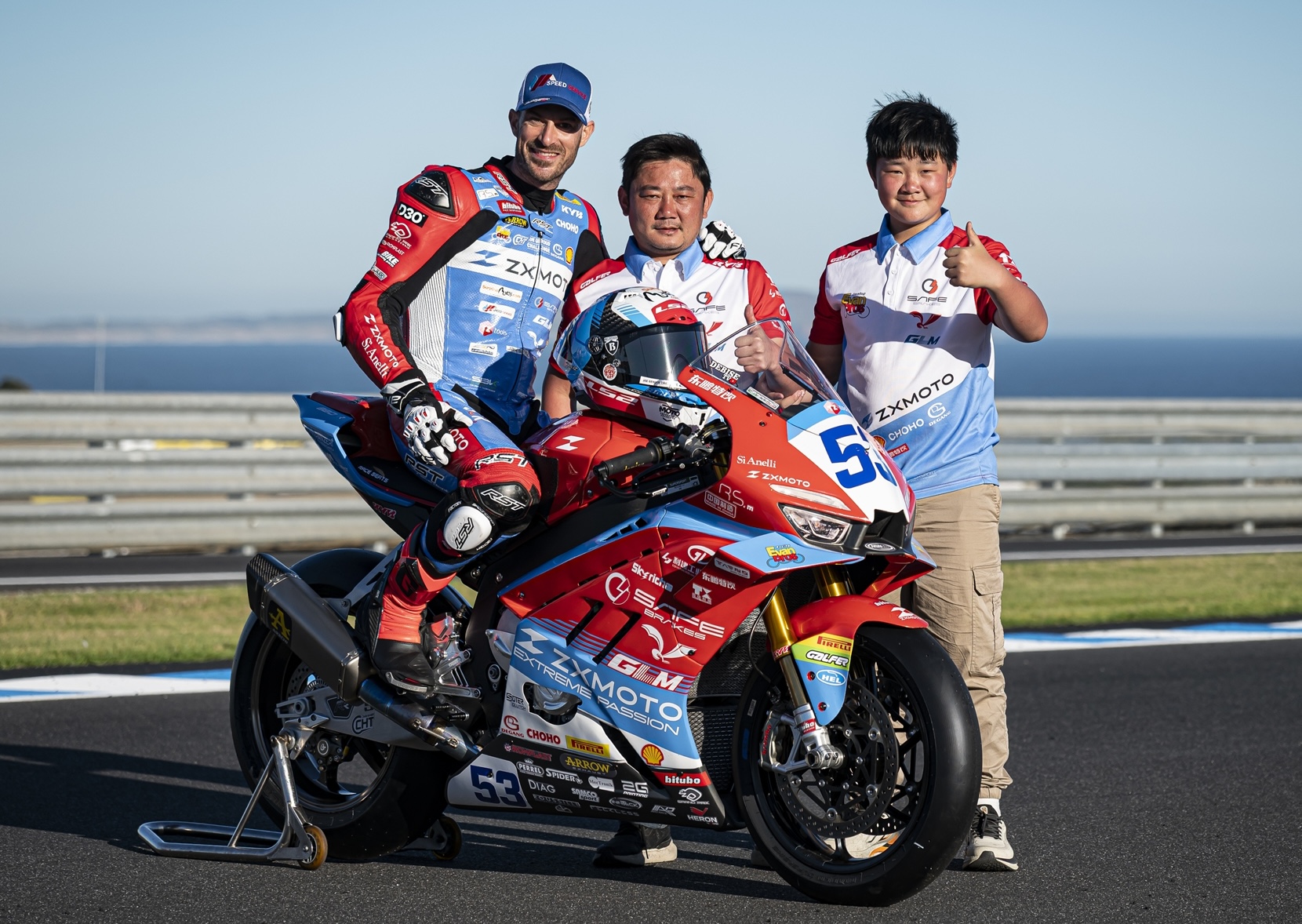
On Saturday, March 28, 2026, Zhang Xue watched a motorcycle race on a screen at a watch party in Chongqing, in southwest China. The race was running at a circuit in Portimão, Portugal, at a Superbike World Championship round in the class known as WorldSSP, where every machine on the track comes from a model a customer can buy.
That rule turns each race into a public test of what a manufacturer can build, and the winners have long come from the same short list of established names: Ducati, Yamaha, Kawasaki, and Honda.
The bike in the lead carried Zhang’s initials. ZXMoto, short for Zhang Xue Motorcycles, had entered the series that season, less than two years after he founded the company in Chongqing.
Its French rider, Valentin Debise, started from second place on the grid, took the lead, and kept stretching it. He crossed the line 3.685 seconds ahead of the next rider, an unusually large margin in a class often decided by fractions of a second.
Sunday’s race asked more of the bike. Debise made a mistake mid-race and dropped to third. He braked later than the two Yamaha riders ahead of him, used the engine’s pull coming out of the corners, and won a second time in two days.
In Chongqing, Zhang pumped his fists so hard that his cap flew off. He cheered, fought back tears, and climbed onto the stage to dance.
“I’ve waited 20 years for this moment,” he said. “I just want to tell the Zhang Xue of 20 years ago: you succeeded!”
The two victories in Portugal were the first WorldSSP race wins by a Chinese manufacturer, and the first came in only ZXMoto’s third world championship race, a month after Debise crashed out of the season’s opening race in Australia. By mid-June, the team had six race wins in its first full season.
Two decades earlier, Zhang was a 19-year-old mechanic in rural Hunan, trying to talk his way onto a racing team. The road from that repair shop to the top step of the podium passed through a racing career that ran out of money, four years on a factory floor in Zhejiang, a move to Chongqing with 20,000 yuan (about $2,900), a company he co-founded and left, and a house he mortgaged to finance his next venture.
Skill comes from falling
Zhang was born in 1987 into a farming family in Mayang county, in the mountains of western Hunan province. His parents divorced when he was young, and he and his younger sister lived with their grandmother in a mud-brick house with a leaking roof. At 14, he got close to a motorcycle for the first time, and the sound of the engine set the direction of his life.
He left school for an apprenticeship at a repair shop, worked from early morning to late at night, and saved 8,000 yuan (about $1,150) for a battered Honda off-road bike. Asked years later which motorcycle has mattered most to him, he still names that one.
He rode it everywhere. One afternoon he aimed it at the front steps of a bank, lost control partway up, and rode into the lobby, where a security guard pinned him and shouted for someone to call the police.
At 17, he opened his own repair shop. Between jobs, he practiced on that Honda along the muddy paths around his village, and the grease he wore earned him a nickname among the people who knew him: wild man. He wanted a place on a racing team.
In 2006, at 19, he called the hotline of a popular Hunan TV program repeatedly until a reporter agreed to meet him. He later admitted to overselling himself. “Actually, my skills weren’t that good back then. I tricked the reporters into coming,” he recalled.
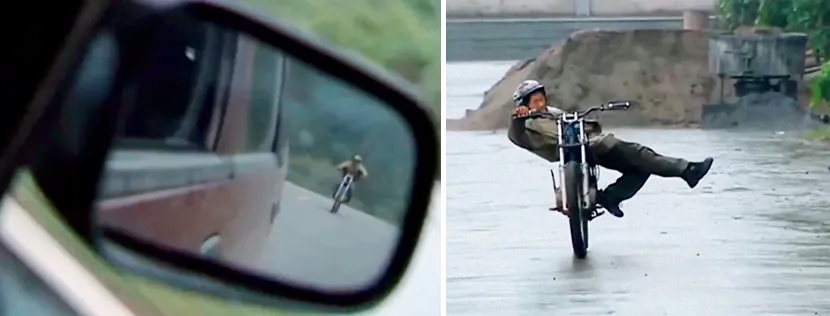
Rain wrecked the shoot. The mountain roads turned to mud, Zhang fell again and again, and the crew said a polite goodbye and drove off to its next location. Zhang climbed back on his motorcycle and followed the van, chasing it through cold rain for more than 100 kilometers and about three hours until the crew agreed to film again.
When the reporter asked whether he was hurt, he said, “Skill comes from falling. This pain really isn’t anything.”
The segment aired, and a racing team called. Zhang sold his shop and joined a private off-road team as a mechanic and apprentice rider. Years later, the reporter who filmed him asked what his life would look like without that broadcast. Zhang told him it would be about the same and offered a four-character phrase: different roads, one destination (殊途同归).
Build the fastest one
The team gave Zhang a track and little else. He arrived with 60,000 yuan (about $8,000) in savings and his old motorcycle, trained without a salary or a professional coach, and won titles in several domestic events.
His height set a ceiling on how far he could go as a rider, and injuries, thin prize money, and a shortage of races at home closed the path. By 2009, his savings were gone, and he was struggling to feed himself. The mechanic who had trained him at the repair shop had already told him where his talent pointed: build the bikes.
“If I couldn’t ride the fastest bike, then I’d build one,” he said.
That year he took a job at Apollo, a motorcycle manufacturer in Jinhua, Zhejiang province, and spent four years learning the whole production system, from vehicle development through manufacturing and supply chain.
Years of tearing down engines had taught him which parts fail. Years of racing gave him a feel for a machine that he could turn into precise feedback for engineers after a few laps. He also saw where the industry stood: large-displacement engines, electronic controls, and precision components arrived as imports.
In 2013, Zhang left for Chongqing with his wife and 20,000 yuan (about $2,900). He rebuilt and modified bikes for other riders, posted the work on motorcycle forums, and turned his following into cash sales, moving more than 100 modified bikes for over 100,000 yuan (about $14,500) and then 200 bikes in a year on Taobao at the top of its category, which paid for tooling of his own.
His first bike design failed. He put roughly 1 million yuan (about $145,000) into it with a low-end supply chain, and he left convinced a proper machine needed five times that. “From the moment he started making his first product in Chongqing, we were borrowing,” his wife, Chen Xingyi, said. The couple borrowed from relatives and friends for years, and they repaid every loan.
In 2017, an investor approached him, and together they co-founded Kove in Chongqing. Kove’s first production bike reached the market in 2018 and sold about 800 units that year. By 2023, the brand was selling about 28,000 motorcycles a year, and Zhang led its first campaign at the Dakar Rally, the off-road endurance race.
The engine bet
At Kove, Zhang pushed for an engine designed in-house, arguing that a manufacturer without one stays at the mercy of its suppliers. A high-performance three-cylinder engine meant years of spending, a long development cycle, and an uncertain return. Kove’s investors weighed that against the profitability the business was already delivering and chose the steadier course. Zhang chose the engine.
“If I don’t build this engine, my life has no meaning,” he said. “If I stayed where I was at the company, the money would still come. That is not what I want. I want to do the things I want to do, the things I think are worth doing.”
In March 2024, Zhang gave up all of his Kove shares and resigned. “After careful consideration, I have decided to pursue my own path among the stars and the sea,” he wrote. “Kove Moto is the accumulation of all the achievements of the first half of my life,” he said later.
He mortgaged his house, raised what he could, and registered ZXMoto in Chongqing a month after resigning. He named the company after himself, a way of putting himself on the line.
The first model, the 500RR, debuted at the China International Motorcycle Trade Exhibition in September 2024. In February 2025, a month before deliveries were due to begin, the company’s account ran dry with payroll coming due.
“I borrowed from my landlord, from my friends, from my suppliers,” he said. “If I knew you, I’d ask you too.” He paid his people on time and sold the first batch of bikes.
Deliveries began in March 2025, on schedule. The 500RR passed 10,000 sales within four months, and ZXMoto closed the year with more than 25,000 motorcycles sold, 750 million yuan (about $109 million) in output value, and nearly 70 million yuan (about $10 million) in research and development.
Three hundredths of a millimeter
Years of repair work gave Zhang a map of how motorcycles break. “I know which structures fail most often. When I started building my own bikes, I knew exactly which designs to avoid,” he said. By about age 20, he could assemble an engine from a pile of parts with his eyes closed, and a television crew filmed him doing it blindfolded.
The engine program put that knowledge to work. His team took a three-cylinder engine to 16,000 rpm, a figure the industry doubted, and pushed suppliers to tighten machining tolerances from five hundredths of a millimeter to three.
The suppliers balked. Zhang offered to cover the cost of the trials himself, on the logic that “if the trials succeeded, everyone would benefit.” “That gave them the motivation to experiment with me,” he said. ZXMoto now mass-produces two engines of its own design.
The engineers come from the same city as the parts. Chongqing holds more than 40 motorcycle manufacturers and over 400 parts suppliers, and more than 90 percent of key components can be sourced locally. ZXMoto employs 230 engineers, with more than 90 percent of them from Chongqing. “Engineers will always be ZXMoto’s most valuable asset,” Zhang said.
He runs the company on the same hands-on terms. “Any problem that comes up, I can be at the site immediately,” he said.
He livestreams for an hour each week so customers can reach him directly. When the street version of the 820RR opened for presale, he barred anyone with less than a year of riding experience from buying one. “When riders use a bike, they can feel whether the engineers and designers put their hearts into it,” he said.
Zhang himself holds no car license and plans to keep it that way. Anything close by he rides, and anything far someone else drives.
The track as a test bench
The rule that puts showroom bikes on the starting grid shapes how ZXMoto develops them. The company set out to prove its engineering in top-tier racing and to build a global brand on track results.
The race bike and the street bike share one development chain: engine output, heat management, the frame, the brakes, electronics calibration, and whole-bike reliability all get tested under race conditions, and what the track exposes feeds the next round of engineering.
The 820RR-RS runs an 819cc inline three-cylinder engine that ZXMoto designed itself, and the company says it reaches 100 kilometers per hour from a standstill in 2.81 seconds. The street 820RR sells in China for 43,800 yuan (about $6,360).
French motorcycle racer Valentin Debise liked the bike from his first ride. Asked what convinced him to sign, he pointed to the founder. “Zhang Xue himself. I wanted to race with this team and nobody else. He does this more for passion than for business,” he said.
Zhang met the wins by looking for what to fix. “I found that our motorcycle still has a problem,” he said. “We are not as fast as our competitors at the starting line. Now we have to think about how to solve this problem, and I have basically figured it out.”
More wins followed at rounds in Hungary, the Czech Republic, and Italy, for six race wins by mid-June. After Portugal, pre-orders for the 820RR jumped 200 percent in three days. “The sales impact has been very noticeable. That’s why we race,” Zhang said.
Going the distance
In August 2026, HSG announced an investment in ZXMoto. The company will keep focusing on engines, complete motorcycles, new-model development, and track validation, and HSG will support its governance, talent, industry resources, and global expansion.
“What moved us most was Zhang Xue’s near-obsessive devotion to the bikes he builds,” said Kevin Su, a Partner at HSG. “His long-held love of motorcycles and racing means he understands riders and is willing to invest in his bikes for the long haul. The best machines come from people who refuse to settle, and we’re excited to build alongside Zhang for years to come as he makes motorcycles that can stand with the best in the world.”
“HSG’s arrival gives ZXMoto a partner that can go the distance with us,” Zhang said. “From here, the team will keep getting our engines and motorcycles right, keep proving them on the track, and keep listening to honest feedback from riders.”
“Just keeping going”
By August, ZXMoto had doubled its workforce since March, and its factory was running around the clock. The next push is overseas. “It has to be global,” Zhang said. He hopes to export 40,000 bikes to Europe in 2027, and an 800-million-yuan factory (about $116 million) is scheduled to open in late 2027.
Around its in-house three-cylinder engine, ZXMoto is building sport, street, rally, touring, and off-road models, and Zhang has set a ten-year goal of placing it among the world’s top 10 motorcycle brands. The company funds a 1-million-yuan (about $145,000) annual prize pool for young Chinese riders racing internationally.
What Zhang counts on is effort. “Maybe I have less talent and fewer resources than others,” he said. “But I put in ten times the work. Why wouldn’t I get there?”
Days after the Portugal wins, a reporter asked Zhang about the 19-year-old who once chased a TV crew through the rain. Zhang paused, and his eyes filled with tears. If the two ever met, he said, “I’d tell him to just keep doing what he wants to do. Just keep going.”